
Answers and qualifies incoming phone calls, books appointments, routes leads, and escalates important inquiries. This reduces reliance on live staff and ensures no call goes unanswered.
Every missed call can mean a missed business opportunity. When customers call to ask questions, request a quote, schedule an appointment, or check service availability, they expect a quick and helpful response. If your team is busy or unavailable, potential customers may contact a competitor instead.
EBCG provides AI voice agent services to help businesses automate phone conversations, respond to customer inquiries, qualify leads, schedule appointments, and manage routine calls more efficiently. Our AI voice solutions use conversational artificial intelligence to understand spoken questions and respond naturally, helping businesses handle incoming and outgoing calls with less manual effort.
Whether you run a local service company, healthcare practice, eCommerce business, or professional service organization, an AI voice agent can help you manage customer conversations, reduce repetitive tasks, and create more opportunities to connect with potential customers.
Answer more calls, capture more leads, and automate customer conversations with AI voice agent solutions from EBCG.
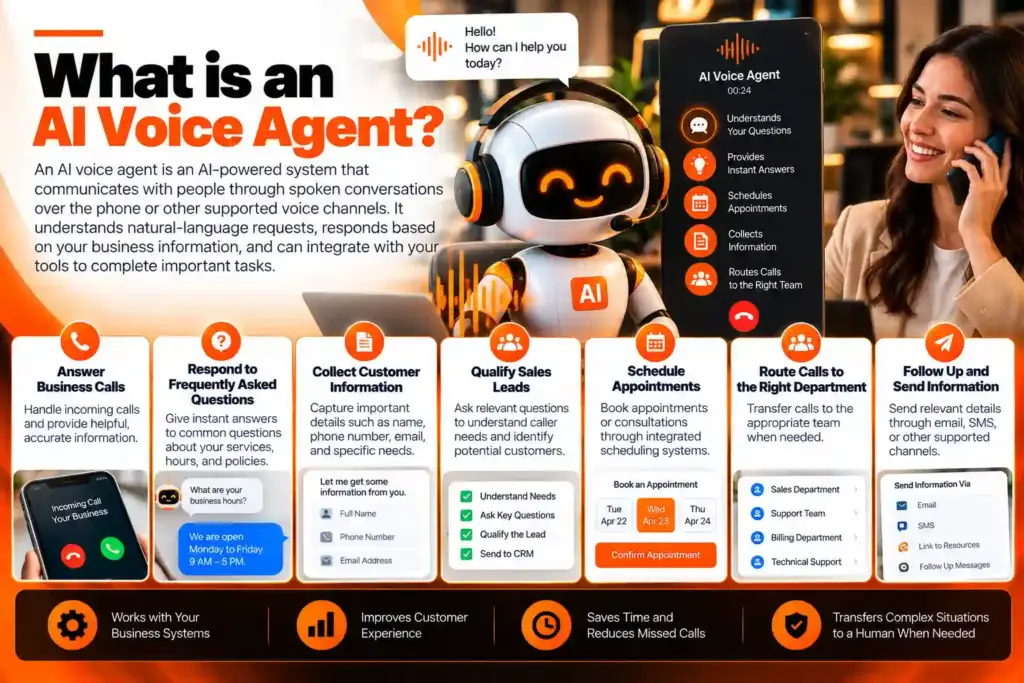
An AI voice agent is an AI-powered system that communicates with people through spoken conversations over the phone or other supported voice channels. It combines speech recognition, language processing, conversational AI, and text-to-speech technology to understand callers and generate spoken responses.
Unlike a traditional phone menu that asks callers to press numbers to select an option, an AI voice agent can understand natural-language requests and respond based on its instructions, knowledge sources, and available integrations.
Depending on its configuration, an AI voice agent can:
Answer incoming business calls.
Respond to frequently asked questions.
Collect customer contact information.
Qualify sales leads.
Schedule appointments or consultations.
Route calls to the appropriate department.
Follow up with customers.
Send relevant information through supported channels.
Connect with CRM and scheduling systems.
AI voice agents are not a replacement for every human conversation. They work best when assigned clear responsibilities, provided with accurate information, and configured to transfer complex or sensitive situations to a human representative.
Phone calls remain an important way for customers to contact businesses. However, managing a high volume of calls can consume valuable time and create delays. AI voice agents can help address these challenges.
Customers may call outside business hours, during weekends, or when your team is handling other tasks. A properly configured AI voice agent can answer calls outside normal operating hours and provide approved information without requiring a staff member to answer every routine inquiry.
Availability depends on your telephony provider, system configuration, and service uptime.
When customers cannot reach your business, they may move on to another provider. An AI voice agent can answer eligible calls, understand the caller’s needs, and collect information for follow-up.
For local businesses, this can be especially useful when potential customers call to request service estimates, check availability, or ask about pricing.
AI voice agents can help callers request appointments, provide scheduling information, or book available time slots when connected to a compatible scheduling system.
This can benefit businesses that regularly receive appointment inquiries, including clinics, consultants, salons, and home service companies.
A booking should only be confirmed when the connected system verifies that the appointment has been successfully scheduled.
An AI voice agent can ask relevant questions to understand what a caller needs before forwarding the inquiry to your sales team.
For example, it can collect the caller’s location, required service, project type, preferred appointment time, and contact information. This helps your team prioritize follow-ups and spend less time gathering basic details.
Employees often spend considerable time answering the same questions about operating hours, services, service areas, booking procedures, and company policies.
An AI voice agent can handle many routine conversations, allowing your team to focus on complex customer needs, sales opportunities, and tasks that require human judgment.
Callers can receive immediate responses to common questions instead of waiting in a queue or for a callback. A well-designed voice agent can also recognize when it cannot answer confidently and direct the caller to the appropriate next step.
EBCG helps businesses plan and implement AI voice solutions based on their communication needs, customer journeys, and existing systems.
Our AI inbound call answering solutions help businesses handle incoming calls when employees are unavailable or when call volume is high.
The voice agent can greet callers, identify their needs, answer common questions, collect relevant information, and route calls according to predefined rules.
Potential use cases include:
Business hours and location inquiries.
Service and product questions.
Estimate and consultation requests.
Appointment inquiries.
Call routing and message taking.
After-hours customer support.
The goal is to make sure callers receive a useful response rather than reaching a dead end.
AI outbound voice agents can support approved business calling workflows, such as appointment reminders, customer follow-ups, and service updates.
Depending on the use case and applicable laws, these workflows may help businesses confirm appointments, remind customers about scheduled services, or follow up on inquiries.
Outbound calling requires careful attention to consent, telemarketing restrictions, privacy requirements, caller identification, and applicable telecommunications rules. We help businesses consider these requirements when planning their voice automation strategy.
An AI voice agent can turn phone conversations into organized business inquiries by collecting relevant details and identifying the caller’s requirements.
For example, a roofing company could configure its voice agent to ask callers about their property location, roofing issue, project timeline, and preferred estimate appointment.
With suitable integrations, collected information can be sent to a CRM or lead management system for follow-up.
We focus on gathering only the information needed for the intended business purpose and handling it appropriately.
For appointment-based businesses, an AI voice agent can help customers schedule consultations or service visits through a connected calendar or booking platform.
The system may check availability, offer eligible time slots, collect required details, and confirm bookings after receiving successful confirmation from the scheduling system.
This can reduce repetitive calls and make the booking process more convenient for customers.
Some customer questions can be resolved quickly without involving a human representative. An AI voice agent can answer approved questions about products, services, policies, delivery procedures, or basic troubleshooting.
When a caller has a complex issue, expresses dissatisfaction, or requests a human, the agent should follow the configured escalation process.
For sensitive industries, such as healthcare and financial services, voice agents need additional controls to protect confidential information and avoid making decisions outside their permitted role.
Local service businesses frequently receive calls from people looking for immediate help. Missed calls can mean missed estimates, appointments, and sales opportunities.
EBCG can help local businesses design voice agent workflows for common customer inquiries.
For example, a cleaning company could use an AI voice agent to identify the type of cleaning required, ask about the property size, confirm whether the address is within its service area, and collect information for a quote.
A plumbing or HVAC company could use a similar workflow to understand the caller’s issue and route urgent requests according to its established procedures.
The agent should not promise service availability or quote prices unless it has access to reliable, current business information.
Connecting your AI voice agent with a CRM can help turn phone conversations into organized business records.
Depending on the systems involved, integrations may support:
Creating or updating lead records.
Recording call summaries.
Assigning inquiries to team members.
Triggering follow-up tasks.
Updating appointment information.
Connecting call activity with sales workflows.
We help plan integrations around your existing business tools, data access permissions, and operational requirements.
Missed calls can create uncertainty for potential customers and extra work for your team. A suitable voice automation workflow can help manage missed-call inquiries by collecting a message, arranging a callback, or initiating an approved follow-up.
The specific workflow depends on your phone system, available integrations, and the caller’s permissions. Automated callbacks or messages should comply with applicable communication and consent requirements.
A voice agent needs regular testing to ensure that it understands common requests and responds appropriately.
Our optimization process can include reviewing conversation quality, improving call scripts and knowledge sources, testing different caller scenarios, refining escalation rules, and identifying situations where the agent misunderstands a request.
We also help define performance indicators, such as call handling rates, successful lead capture, appointment outcomes, transfer rates, and caller satisfaction where measurable.
(513) 775-3224
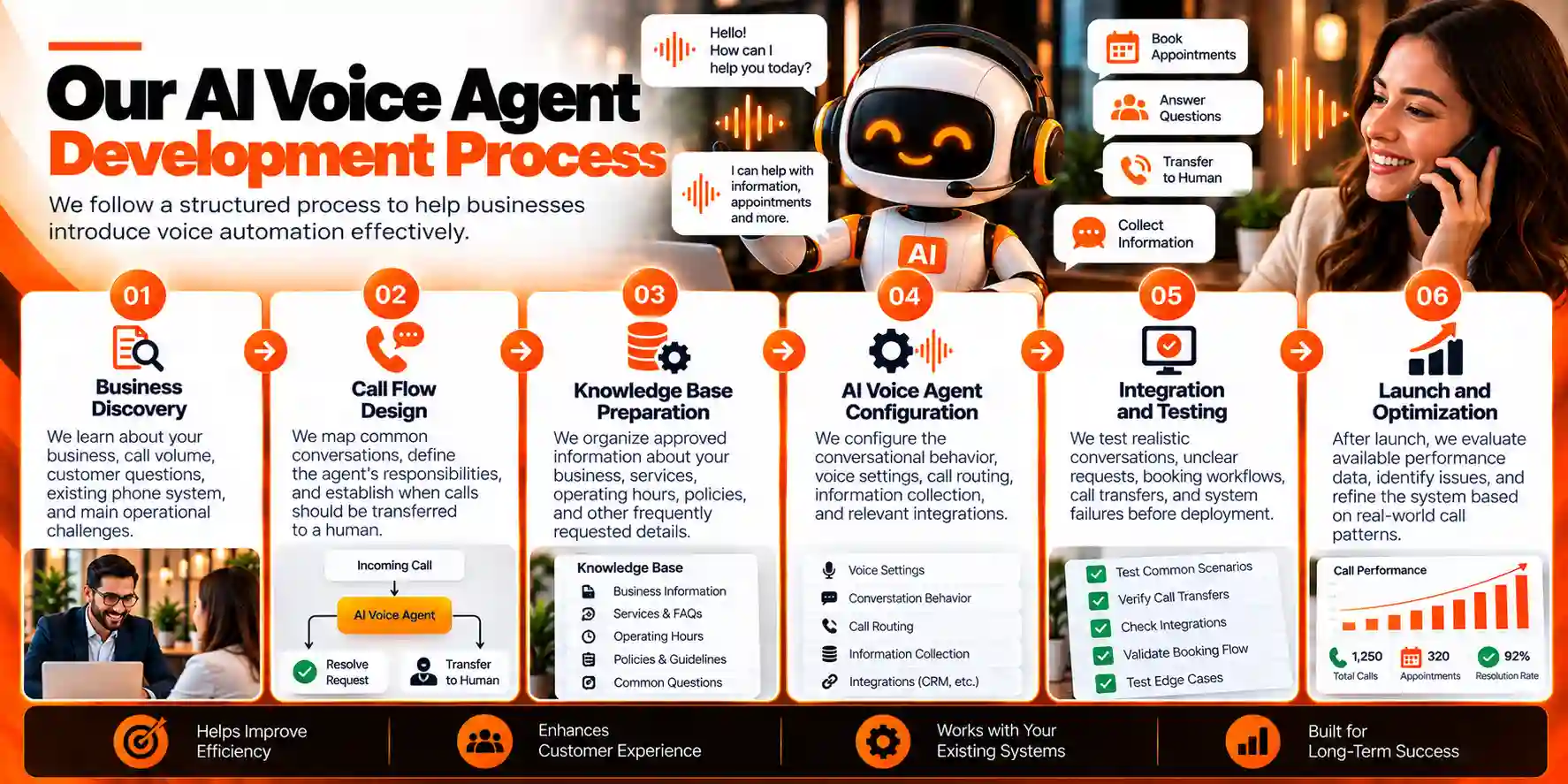
We follow a structured process to help businesses introduce voice automation effectively.
Step 1: Business Discovery
We learn about your business, call volume, customer questions, existing phone system, and main operational challenges.
Step 2: Call Flow Design
We map common conversations, define the agent’s responsibilities, and establish when calls should be transferred to a human.
Step 3: Knowledge Base Preparation
We organize approved information about your business, services, operating hours, policies, and other frequently requested details.
Step 4: AI Voice Agent Configuration
We configure the conversational behavior, voice settings, call routing, information collection, and relevant integrations.
Step 5: Integration and Testing
We test realistic conversations, unclear requests, booking workflows, call transfers, and system failures before deployment.
Step 6: Launch and Optimization
After launch, we evaluate available performance data, identify issues, and refine the system based on real-world call patterns.
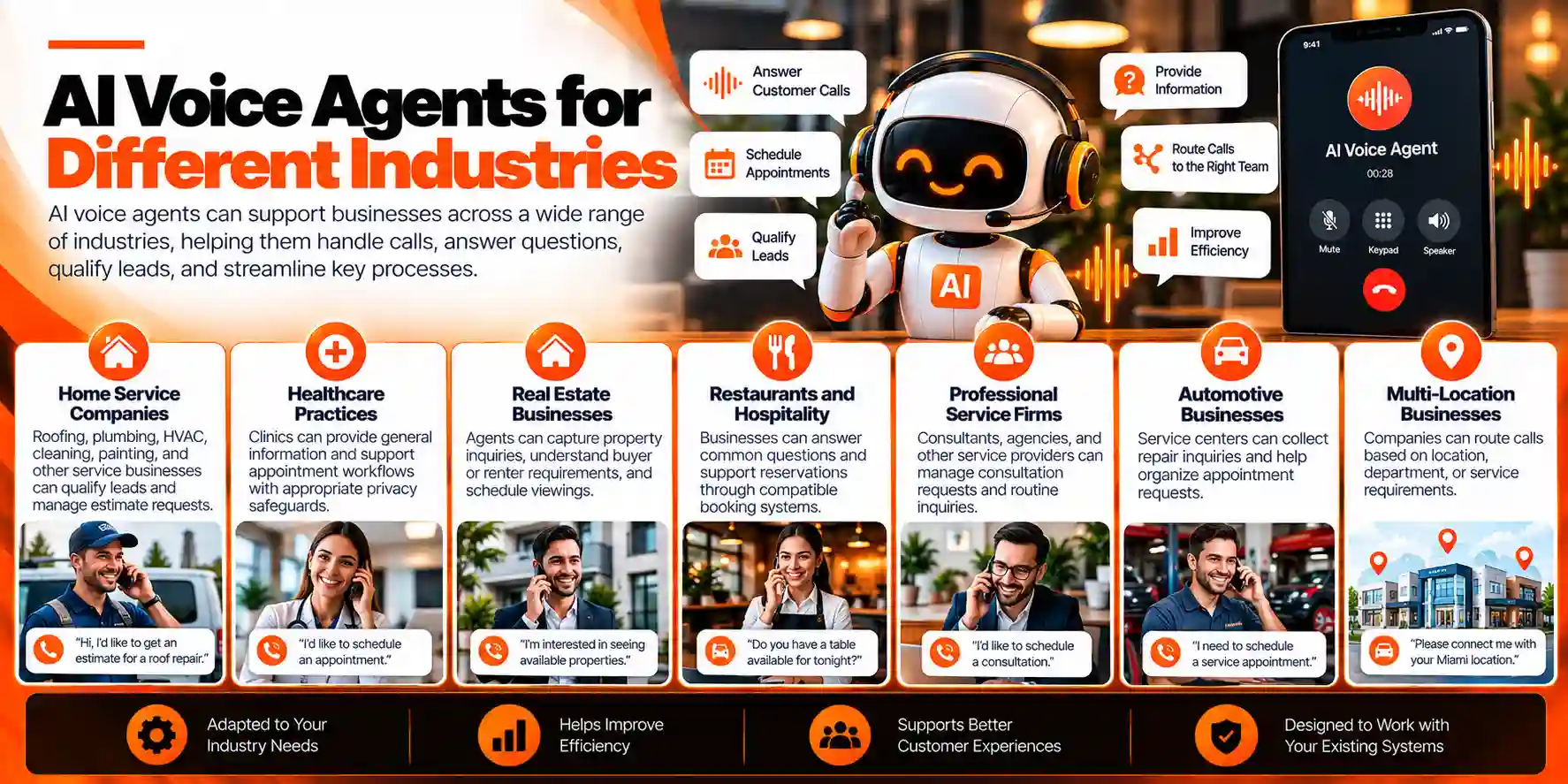
AI voice agents can support businesses across a wide range of industries.
Home service companies: Roofing, plumbing, HVAC, cleaning, painting, and other service businesses can qualify leads and manage estimate requests.
Healthcare practices: Clinics can provide general information and support appointment workflows with appropriate privacy safeguards.
Real estate businesses: Agents can capture property inquiries, understand buyer or renter requirements, and schedule viewings.
Restaurants and hospitality: Businesses can answer common questions and support reservations through compatible booking systems.
Professional service firms: Consultants, agencies, and other service providers can manage consultation requests and routine inquiries.
Automotive businesses: Service centers can collect repair inquiries and help organize appointment requests.
Multi-location businesses: Companies can route calls based on location, department, or service requirements.
The best solution depends on your call volume, customer expectations, operational processes, and existing technology.
EBCG focuses on practical AI voice solutions that help businesses improve communication and manage routine phone tasks more efficiently.
Business-focused strategy: We align voice automation with your operational goals and customer journey.
Natural conversation design: We aim to create clear, helpful interactions rather than rigid, confusing phone menus.
Lead generation support: We help structure calls to capture relevant information and support timely follow-ups.
System integration planning: We consider how voice agents can work with your CRM, calendar, and phone system.
Human handoff options: We define escalation processes for complex questions and situations that need personal attention.
Continuous improvement: We help identify gaps in conversation quality and opportunities to improve performance.
Our goal is to help you automate appropriate phone tasks while preserving the human support customers need.
EBCG © copyright 2026. All rights reserved.