
Eengages website visitors, answers questions, books appointments, and captures leads around the clock — even when your team is unavailable.
Customers expect quick answers when they visit your website, explore your services, or look for information about your business. If they cannot find the information they need, they may leave without contacting you. An AI chatbot can help bridge this gap by answering common questions, guiding visitors, and helping potential customers take the next step.
EBCG provides AI chatbot services to help businesses automate customer conversations, improve website engagement, generate leads, and deliver faster customer support. We help businesses implement chatbot solutions that understand customer questions, provide relevant information, and support important business processes.
Whether you operate a local service business, an eCommerce store, a professional agency, or a growing company, our AI chatbot solutions can help you handle routine inquiries while giving your team more time to focus on valuable customer interactions.
Answer questions faster, capture more opportunities, and create a better customer experience with AI-powered chatbots.
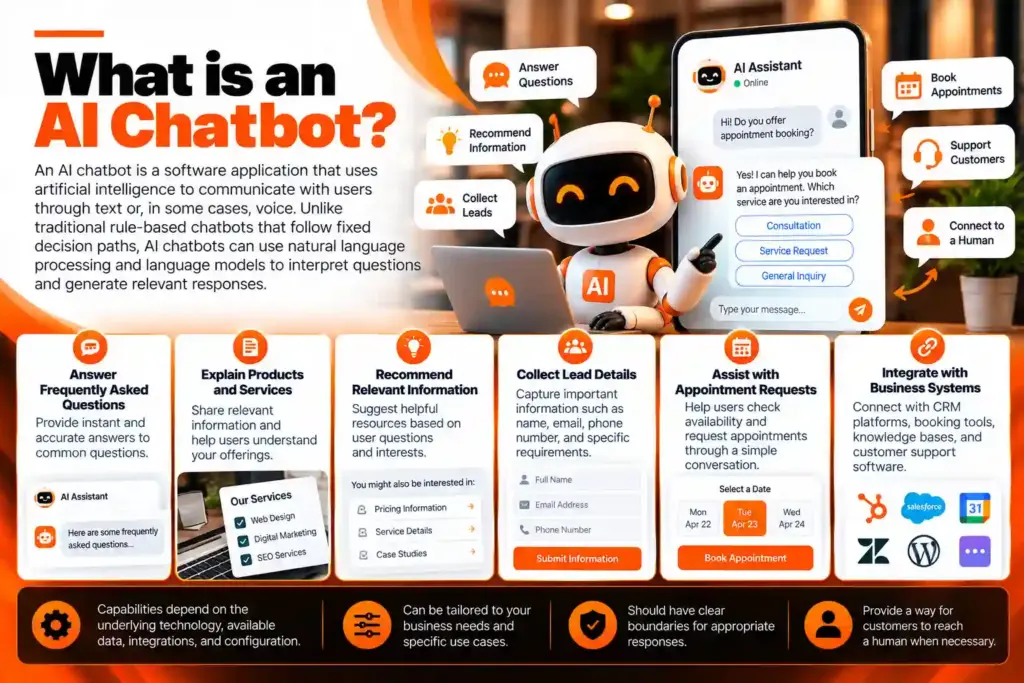
An AI chatbot is a software application that uses artificial intelligence to communicate with users through text or, in some cases, voice. Unlike traditional rule-based chatbots that follow fixed decision paths, AI chatbots can use natural language processing and language models to interpret questions and generate relevant responses.
Depending on how it is configured, an AI chatbot can answer frequently asked questions, explain products and services, recommend relevant information, collect lead details, assist with appointment requests, and connect users with a human representative.
Modern AI chatbots can also integrate with business systems such as customer relationship management (CRM) platforms, booking tools, knowledge bases, and customer support software.
The capabilities of each chatbot depend on its underlying technology, available data, integrations, and configuration. A well-designed solution should have clear boundaries and provide a way for customers to reach a human when necessary.
An AI chatbot can help businesses respond to customer needs more efficiently while creating additional opportunities to generate leads and improve service delivery.
Customers may visit your website outside regular business hours or when your team is busy. An AI chatbot can answer common questions and provide useful information without requiring a staff member to respond to every inquiry manually.
Depending on its setup, it can support customers around the clock, including outside your normal operating hours.
An AI chatbot can ask visitors relevant questions about their needs, location, budget, service requirements, or preferred contact method. This information can help your team understand the inquiry before following up.
For service businesses, this may mean identifying visitors who need a quote, consultation, appointment, or service estimate.
Website visitors often need clarification before making a decision. A chatbot can help them understand your services, find relevant pages, compare options, and move toward a suitable next step.
By reducing friction in the customer journey, chatbot conversations can support conversions such as calls, form submissions, bookings, and purchases. Actual results depend on the website, chatbot quality, traffic, and customer needs.
Your team may spend significant time answering the same questions about pricing, service areas, business hours, policies, and availability. An AI chatbot can handle many routine inquiries, allowing employees to focus on complex questions and tasks that require human judgment.
A chatbot connected to an approved knowledge base can provide consistent answers about your business, services, and policies. This can reduce confusion and help customers access accurate information more easily.
As inquiry volume increases, responding to every message manually can become difficult. An AI chatbot can help manage routine conversations at scale, provided the system is designed with appropriate capacity, monitoring, and escalation processes.
EBCG provides AI chatbot solutions tailored to your business goals, customer journey, website, and existing software.
We help businesses plan and implement AI chatbot solutions based on their specific needs. This includes identifying common customer questions, defining chatbot objectives, organizing relevant information, designing conversation flows, and configuring suitable AI technology.
We focus on creating a chatbot that serves a clear business purpose rather than adding a feature that does not support your customers or team.
Depending on your requirements, the chatbot may be deployed on your website or through a supported messaging platform.
Your website is often one of the first places customers go to learn about your business. An AI chatbot can help visitors find information without searching through multiple pages.
We help integrate chatbot experiences into suitable websites, including WordPress and other compatible platforms.
The chatbot can be configured to help visitors:
Understand your products and services.
Find answers to frequently asked questions.
Explore relevant service pages.
Request a quote or consultation.
Submit contact information.
Navigate to booking or contact forms.
Connect with your team when additional support is needed.
Integration options depend on the website platform and chatbot provider.
An AI lead generation chatbot helps turn conversations into potential business opportunities. Instead of relying only on static contact forms, businesses can guide visitors through a conversational process.
We can help configure the chatbot to ask relevant qualifying questions, collect contact details with appropriate consent, identify the visitor’s needs, and direct qualified inquiries to the right team.
For example, a roofing company could use an AI chatbot to ask about the property location, type of roofing service required, and preferred time for an estimate.
This approach can help businesses organize incoming leads and reduce unnecessary back-and-forth communication.
Customer support chatbots help businesses respond to routine inquiries and provide information based on approved resources.
We can help configure responses for topics such as service details, business hours, delivery information, account instructions, common troubleshooting steps, and company policies.
For questions that require human judgment, account-specific access, or sensitive decision-making, the chatbot should direct customers to an appropriate representative instead of guessing.
For businesses that depend on appointments, consultations, or service visits, a chatbot can help customers move toward booking more conveniently.
Depending on available integrations, the chatbot may collect appointment preferences, explain booking requirements, provide a scheduling link, or check availability through a connected booking system.
Potential use cases include healthcare appointment inquiries, consultation requests, home service estimates, and business meetings.
Live availability and confirmed bookings require a reliable connection to the relevant scheduling system. The chatbot should not claim that an appointment is confirmed unless the system verifies it.
Local businesses often receive repeated questions about service areas, pricing, operating hours, directions, and appointment availability.
We help configure AI chatbots to answer these questions using accurate business information and guide potential customers toward relevant actions.
For example, a cleaning company chatbot could explain available cleaning services, ask about property size, collect the customer’s preferred schedule, and guide them to request a quote.
A properly configured chatbot can complement your Google Business Profile and local SEO efforts by helping website visitors take the next step after discovering your business. It does not replace the need for accurate business listings or a well-optimized website.
Online stores can use AI chatbots to help shoppers discover products, understand product features, and find answers to common purchasing questions.
Depending on integrations and permissions, an eCommerce chatbot may assist with:
Product information and recommendations.
Frequently asked questions about shipping and returns.
Product comparisons.
Navigation to relevant product categories.
Order-status inquiries through connected systems.
Guidance toward checkout or customer support.
The chatbot should rely on accurate product and policy information and should not invent stock availability, delivery dates, prices, or order details.
An AI chatbot becomes more useful when it works with the systems your business already uses.
Depending on platform compatibility, we can help plan integrations with CRM software, lead management tools, scheduling systems, help desks, and business knowledge bases.
Possible workflows include sending qualified inquiries to your CRM, assigning leads to the appropriate team, creating follow-up tasks, and organizing conversation information.
Integrations should follow appropriate access controls and data protection practices.
An AI chatbot needs ongoing evaluation to remain useful as your business changes.
Our optimization approach can include reviewing conversation logs where appropriate, identifying unanswered questions, improving the knowledge base, refining instructions, testing important user journeys, and evaluating escalation behavior.
We can also help identify when the chatbot should provide a direct answer, ask a clarifying question, or transfer the conversation to a human.
(513) 775-3224
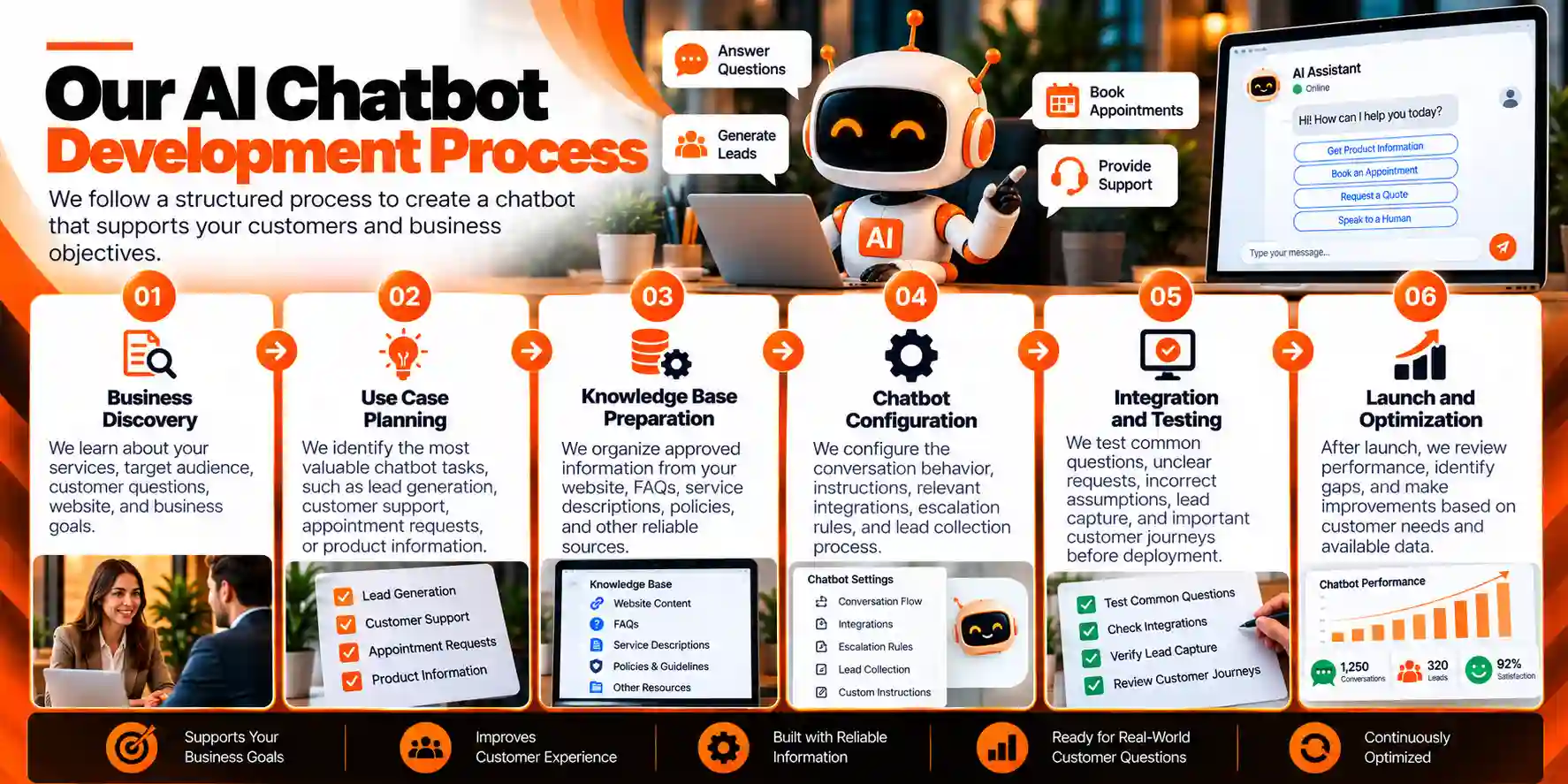
We follow a structured process to create a chatbot that supports your customers and business objectives.
Step 1: Business Discovery
We learn about your services, target audience, customer questions, website, and business goals.
Step 2: Use Case Planning
We identify the most valuable chatbot tasks, such as lead generation, customer support, appointment requests, or product information.
Step 3: Knowledge Base Preparation
We organize approved information from your website, FAQs, service descriptions, policies, and other reliable sources.
Step 4: Chatbot Configuration
We configure the conversation behavior, instructions, relevant integrations, escalation rules, and lead collection process.
Step 5: Integration and Testing
We test common questions, unclear requests, incorrect assumptions, lead capture, and important customer journeys before deployment.
Step 6: Launch and Optimization
After launch, we review performance, identify gaps, and make improvements based on customer needs and available data.
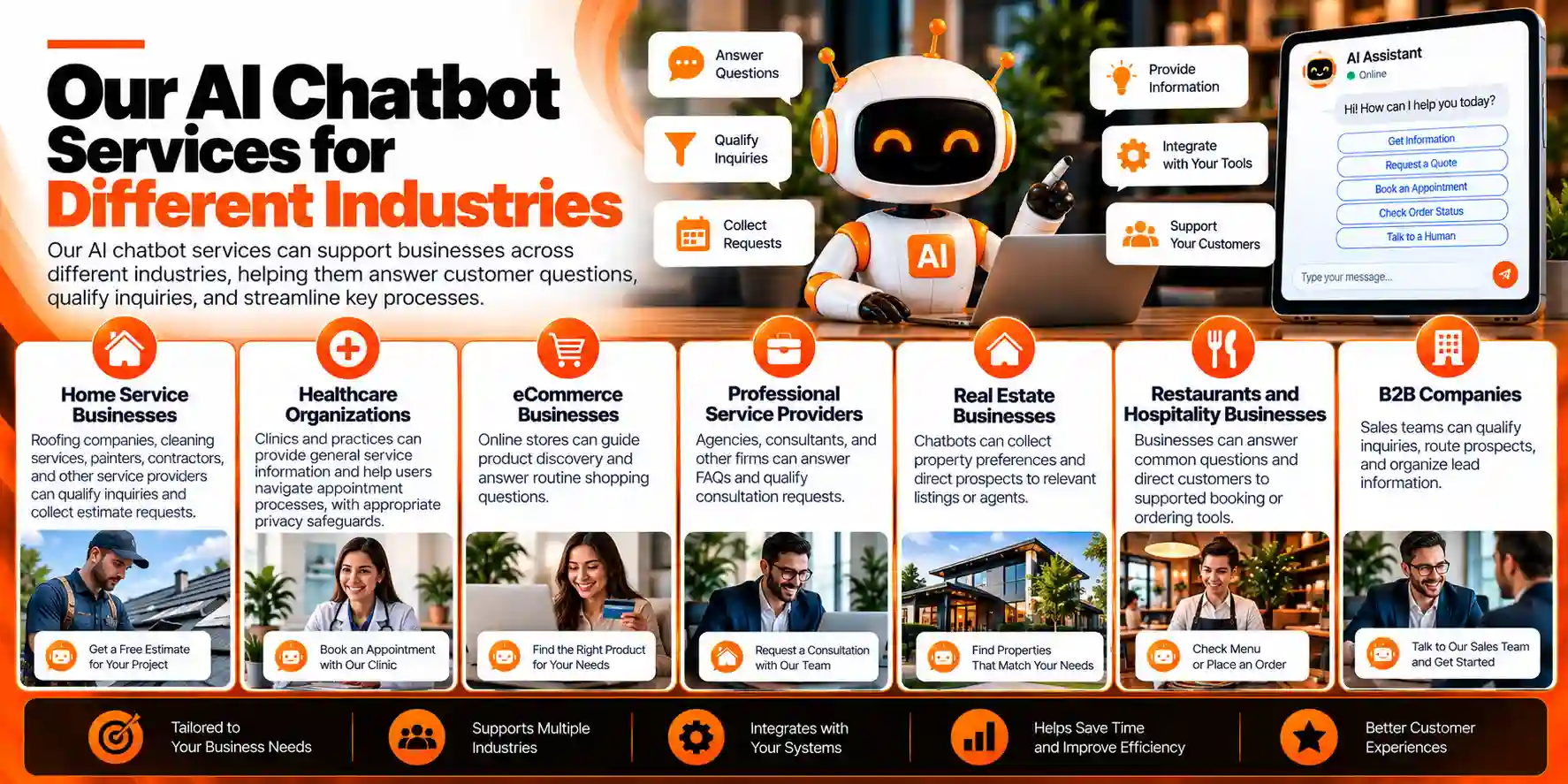
Our AI chatbot services can support businesses across different industries.
Home service businesses: Roofing companies, cleaning services, painters, contractors, and other service providers can qualify inquiries and collect estimate requests.
Healthcare organizations: Clinics and practices can provide general service information and help users navigate appointment processes, with appropriate privacy safeguards.
eCommerce businesses: Online stores can guide product discovery and answer routine shopping questions.
Professional service providers: Agencies, consultants, and other firms can answer FAQs and qualify consultation requests.
Real estate businesses: Chatbots can collect property preferences and direct prospects to relevant listings or agents.
Restaurants and hospitality businesses: Businesses can answer common questions and direct customers to supported booking or ordering tools.
B2B companies: Sales teams can qualify inquiries, route prospects, and organize lead information.
The right chatbot depends on your customers, the tasks you want to automate, and the systems available to support those tasks.
EBCG focuses on practical AI chatbot solutions that support business growth and improve the customer experience.
Business-focused strategy: We align chatbot functionality with your customer journey and business goals.
Customer-friendly conversations: We prioritize clear language, helpful answers, and straightforward navigation.
Lead generation support: We help create conversational processes that collect relevant inquiry information.
Integration planning: We consider how the chatbot can work with your existing website and business systems.
Responsible AI configuration: We emphasize approved information, clear limitations, and human escalation for complex questions.
Continuous improvement: We help identify performance gaps and opportunities to improve chatbot usefulness.
Our goal is not simply to install an AI chatbot. It is to help you build a useful digital assistant that supports your customers and your team.
EBCG © copyright 2026. All rights reserved.