
Enables more users — including those with disabilities — to engage with your site. This supports ADA and WCAG compliance and expands your potential audience.
Your website should be easy to use for every visitor, including people with disabilities. EBCG provides website accessibility services to help businesses create more inclusive, user-friendly, and accessible digital experiences. We identify accessibility barriers, improve website usability, and help your business work toward recognized accessibility standards such as the Web Content Accessibility Guidelines (WCAG).
Whether you run a business website, an eCommerce store, or a service-based website, our website accessibility solutions help make your content easier to navigate, understand, and interact with across different devices and assistive technologies.
Make your website more accessible, improve the user experience, and help more people connect with your business.
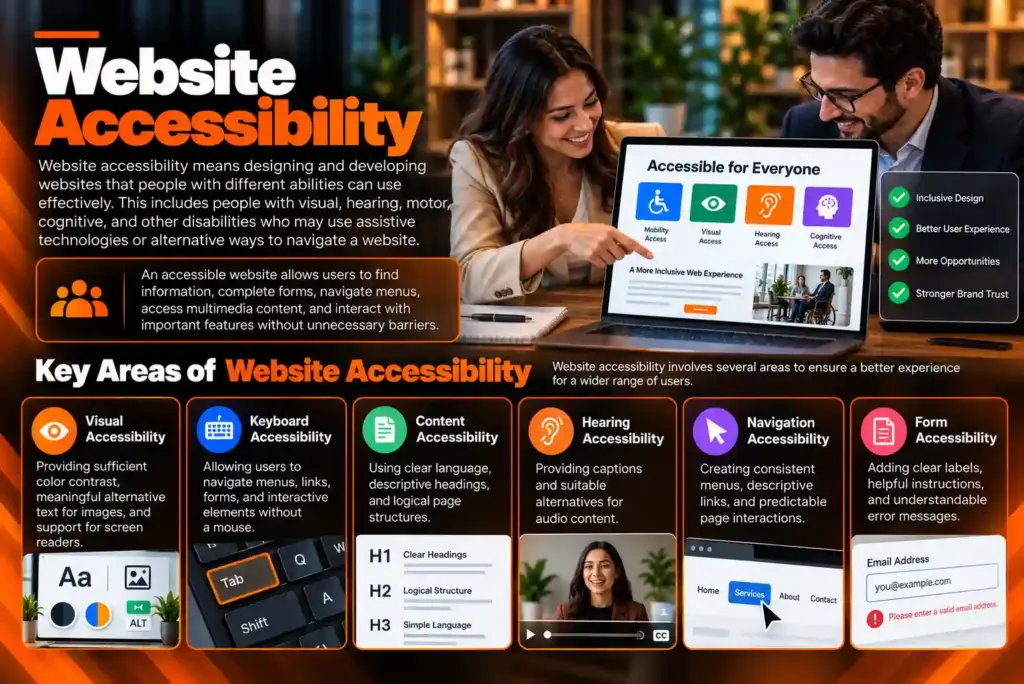
Website accessibility means designing and developing websites that people with different abilities can use effectively. This includes people with visual, hearing, motor, cognitive, and other disabilities who may use assistive technologies or alternative ways to navigate a website.
An accessible website allows users to find information, complete forms, navigate menus, access multimedia content, and interact with important features without unnecessary barriers.
Website accessibility involves several areas, including:
Visual accessibility: Providing sufficient color contrast, meaningful alternative text for images, and support for screen readers.
Keyboard accessibility: Allowing users to navigate menus, links, forms, and interactive elements without a mouse.
Content accessibility: Using clear language, descriptive headings, and logical page structures.
Hearing accessibility: Providing captions and suitable alternatives for audio content.
Navigation accessibility: Creating consistent menus, descriptive links, and predictable page interactions.
Form accessibility: Adding clear labels, helpful instructions, and understandable error messages.
A website that supports accessibility can offer a better experience for a wider range of users.
Website accessibility is an important part of building a professional and inclusive online presence. When users cannot navigate your website or understand its content, they may leave without contacting your business, making a purchase, or completing an important action.
Our website accessibility services help address common barriers and improve the overall usability of your website.
Accessible websites are often easier to navigate, read, and interact with. Clear headings, logical layouts, descriptive links, and properly labeled forms help visitors find information with less effort.
Accessibility improvements help people with disabilities access your website more effectively. They can also benefit users browsing on mobile devices, using voice controls, or navigating in different environments.
Many accessibility practices overlap with good SEO and web development practices. Descriptive headings, meaningful image alt text, clear navigation, and well-structured content can help users and search engines understand your website. Accessibility improvements alone, however, do not guarantee higher search rankings.
We help businesses evaluate their websites against relevant accessibility criteria, including WCAG. This provides a practical foundation for identifying issues and planning improvements.
Difficult forms, inaccessible buttons, confusing navigation, and poorly labeled interactive elements can prevent visitors from completing actions. Addressing these issues can make important conversion paths easier to use.
An accessible website helps communicate that your business values usability and aims to serve customers with different needs.
EBCG provides website accessibility solutions tailored to your website’s structure, platform, features, and business goals.
Our website accessibility audit evaluates your website for common accessibility barriers. We review key pages and user journeys to identify issues that may affect people using assistive technologies or alternative navigation methods.
The audit may include checks for color contrast, heading structure, image alternative text, keyboard navigation, form labels, link descriptions, and interactive components. Automated testing can identify some issues, while manual testing is important for evaluating real usability concerns.
You receive prioritized findings and practical recommendations to guide remediation.
We assess your website against applicable Web Content Accessibility Guidelines (WCAG) criteria to help identify areas that may require improvement.
WCAG is organized around four core principles: content should be perceivable, operable, understandable, and robust. We use these principles to help structure accessibility reviews and remediation priorities.
The appropriate WCAG version and conformance level depend on your requirements. An assessment or automated scan should not be treated as a guarantee of full compliance or legal compliance.
Screen readers help people with visual impairments access digital content. However, missing image descriptions, incorrect heading structures, unlabeled controls, and confusing page announcements can create significant barriers.
We review and help improve screen reader support by addressing semantic HTML, accessible names, image alt text, form labels, heading hierarchy, and other relevant elements.
Some users navigate websites entirely with a keyboard instead of a mouse. Your website should allow them to access important content and interactive features efficiently.
Our service reviews keyboard navigation, focus indicators, tab order, menus, dialogs, and interactive controls. We also look for keyboard traps that may prevent users from moving through or leaving an interface.
Text and interface elements need sufficient contrast to remain distinguishable for users with low vision or certain color vision deficiencies.
We review text contrast, button visibility, form controls, visual indicators, and other interface elements. Where needed, we recommend accessible color combinations and design improvements without compromising your brand identity unnecessarily.
Contact forms, booking forms, checkout pages, and other interactive features should be understandable and usable.
We review form labels, instructions, required fields, error messages, validation feedback, buttons, and dynamic content. The goal is to help users understand what information is needed and how to correct mistakes.
An audit is only the first step. Our website accessibility remediation service helps address identified issues through practical design and development improvements.
Depending on your website, remediation may involve improving HTML structure, updating components, correcting labels, adjusting contrast, improving keyboard support, or revising inaccessible content.
We can also help establish a plan for ongoing testing as your website changes.
Website accessibility requires continued attention because new content, plugins, design changes, and features can introduce new barriers.
We can help create a repeatable testing process for important pages and user journeys. This may include automated scans, manual keyboard checks, assistive technology testing, and periodic reviews after significant updates.
(513) 775-3224
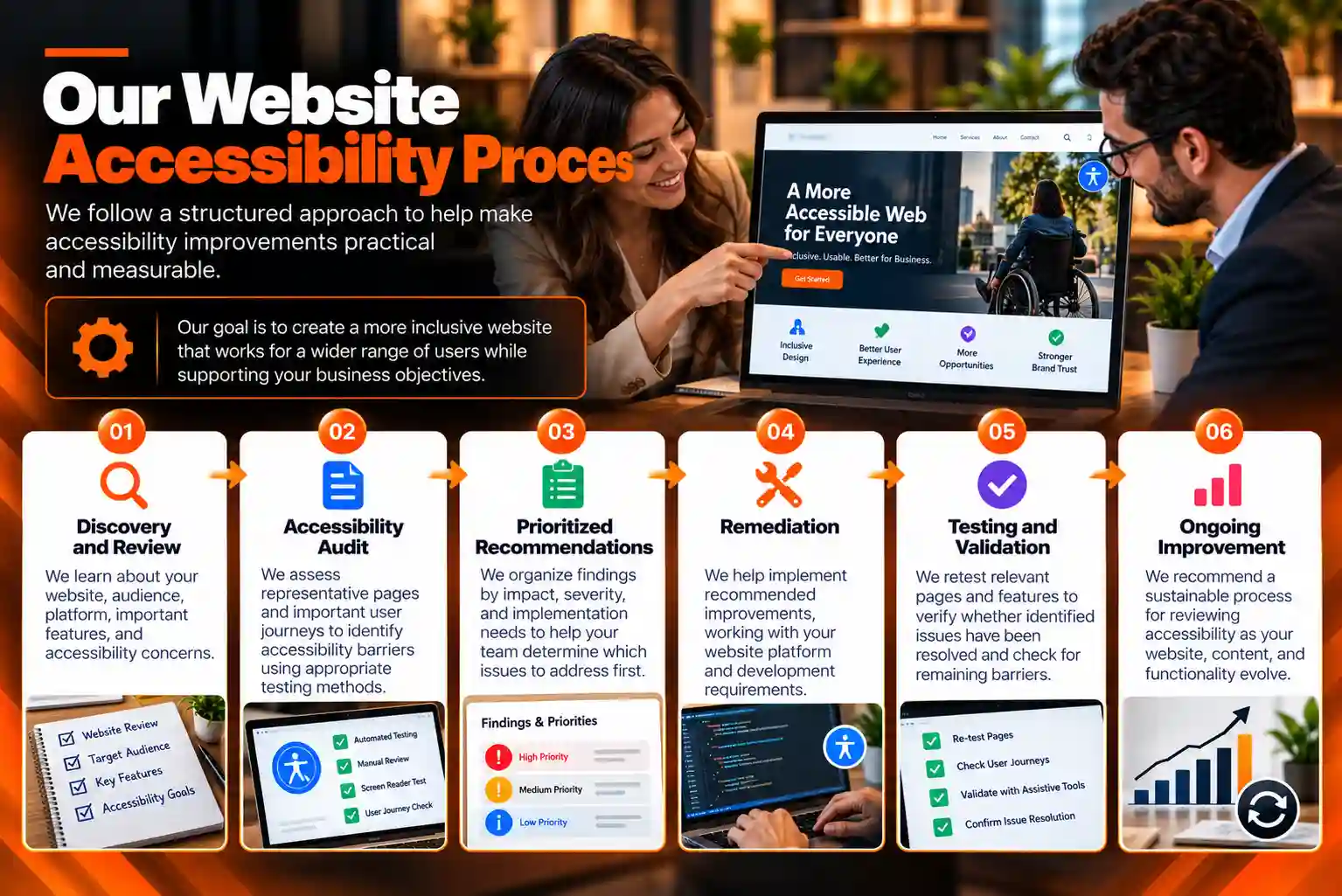
We follow a structured approach to help make accessibility improvements practical and measurable.
Step 1: Discovery and Review
We learn about your website, audience, platform, important features, and accessibility concerns.
Step 2: Accessibility Audit
We assess representative pages and important user journeys to identify accessibility barriers using appropriate testing methods.
Step 3: Prioritized Recommendations
We organize findings by impact, severity, and implementation needs to help your team determine which issues to address first.
Step 4: Remediation
We help implement recommended improvements, working with your website platform and development requirements.
Step 5: Testing and Validation
We retest relevant pages and features to verify whether identified issues have been resolved and check for remaining barriers.
Step 6: Ongoing Improvement
We recommend a sustainable process for reviewing accessibility as your website, content, and functionality evolve.
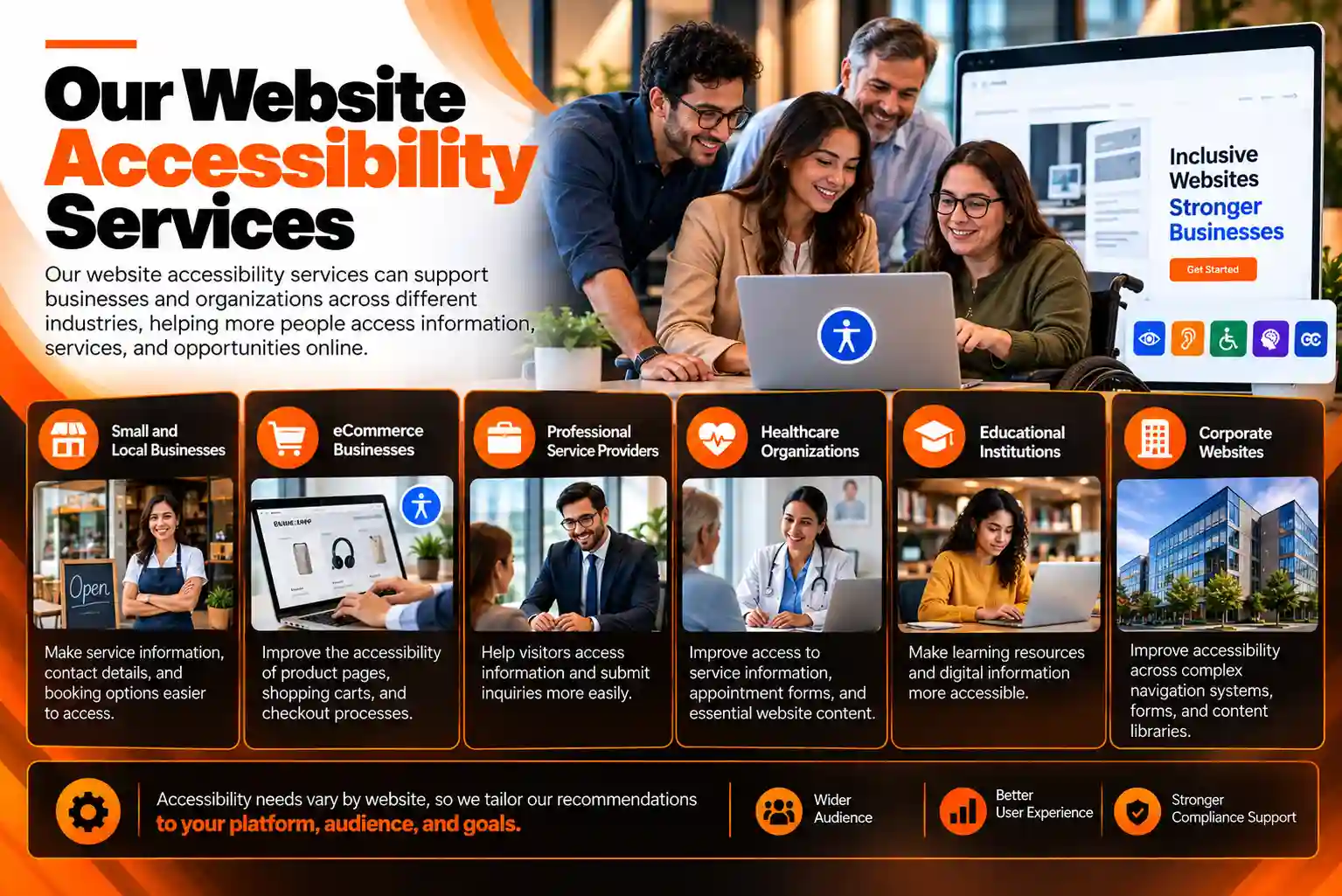
Our website accessibility services can support businesses and organizations across different industries, including:
Small and local businesses: Make service information, contact details, and booking options easier to access.
eCommerce businesses: Improve the accessibility of product pages, shopping carts, and checkout processes.
Professional service providers: Help visitors access information and submit inquiries more easily.
Healthcare organizations: Improve access to service information, appointment forms, and essential website content.
Educational institutions: Make learning resources and digital information more accessible.
Corporate websites: Improve accessibility across complex navigation systems, forms, and content libraries.
Accessibility needs vary by website, so we tailor our recommendations to your platform, audience, and goals.
EBCG focuses on practical improvements that support accessibility, usability, and better digital experiences.
User-focused approach: We consider how people with different abilities interact with your website.
Actionable recommendations: We explain identified issues and suggest practical ways to address them.
Standards-informed reviews: We use relevant WCAG guidance to structure accessibility assessments.
SEO-aware improvements: We consider how accessibility practices align with content structure, navigation, and website usability.
Prioritized remediation: We help focus on meaningful barriers instead of relying only on automated scan scores.
Ongoing support: We help businesses build accessibility checks into their website maintenance process.
Our goal is to help you create a website that is easier for more people to use, while supporting your broader digital business objectives.
EBCG © copyright 2026. All rights reserved.